
Zajímá vás, jak proběhl náš jarní retourový refresher s Roderickem Jonesem? Přečtěte si zprávu přímo od něj:
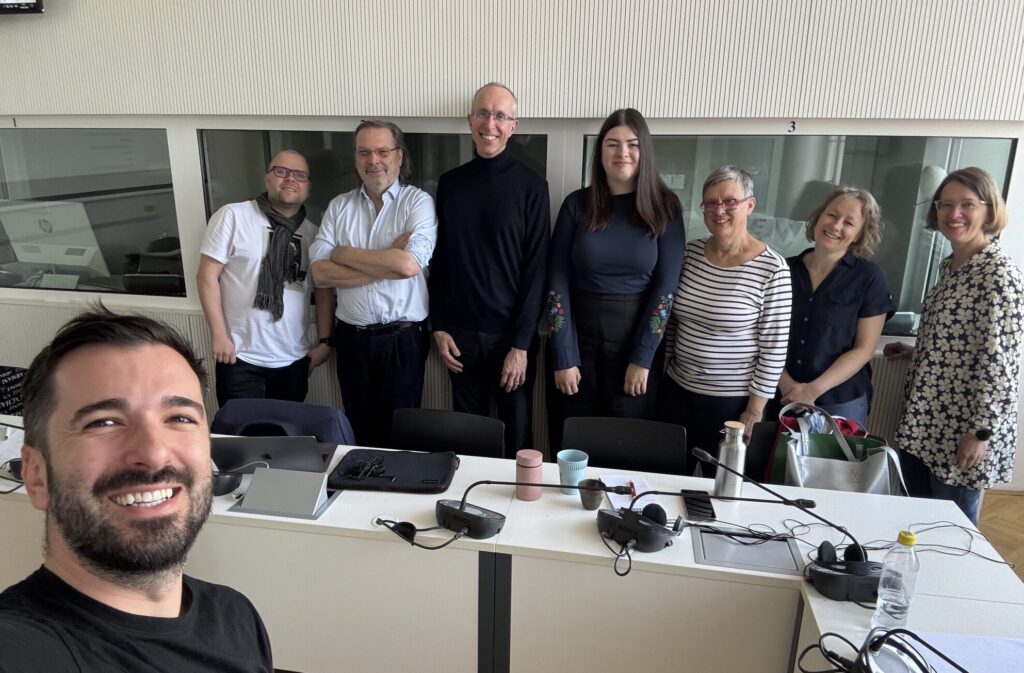
On 17th and 18th April 2026 ASKOT organised an English retour training session for colleagues. They kindly invited me to be the trainer. We worked in the main building of FFUK, thanks to the usual impeccable cooperation with ÚTRL.
Seven colleagues attended the two three-hour sessions, one on Friday afternoon, the second on Saturday morning. Their motivations were varied. Some were there to gauge their own level and to ask me to provide advice on whether they were up to standard for the EU institutions. Some came essentially to have extra practice. And one colleague who has an accredited retour into French in the EU institutions came to practice English retour, as that is more frequently required by the local market here in Prague. In that last case, although I knew the colleague in question, I had forgotten their “official” EU retour was into French, and their English retour was so good I naturally assumed English was their normal retour language!
I was struck by two things above all. One was quite simply the high standard of the retours. I did my best to give useful feedback to the colleagues, but many of my comments could be summed up with, “Fine, there is little or nothing to criticise.” The second was the kindness, courtesy and patience of the colleagues. Inevitably, now and again I made mistakes myself – particularly towards the end, as fatigue set in – and colleagues were always happy to discuss, correct, and look for alternative solutions to interpreting or terminological problems.
I also learned how difficult it is to gauge the difficulty of speeches. In advance of the sessions I had prepared fifteen speeches from the Internet (in practice we only had time to do ten of them). I listened to them all, trying to assess their difficulty and to find a mix of topics, in particular varying between political speeches and non-political discussion of topical issues, such as energy supply, AI and so on. I chose the new year address of the President of the Republic as the first speech to practice from. “He speaks slowly and clearly in short sentences, addressing the ordinary citizen, a nice, easy, warm-up speech,” I said to myself. But the colleagues found it challenging, as President Pavel hopped from topic to topic quickly, provided lists, including proper names which would mostly be unknown to non-Czechs, and overall had a highly formal, elevated tone, becoming to a President of the Republic of course, but difficult to cope with in the booth. On the other hand, a speech about AI, which I found conceptually difficult, was no problem at all for the colleagues, no doubt used to discussing the issue frequently, and they interpreted it much better than I could have done. A lesson for any possible future repeats of such sessions.
Another lesson for me concerned the intensity of the practice. We had two three-hour sessions, and in each we had only a ten-minute break. Despite the fact that some time was devoted to feedback and discussion, this meant that the colleagues were working extremely intensively and by the end of each session must have been extremely tired. Any future similar workshop should build in two breaks of around a quarter of an hour, or one longer break of half an hour.
In conclusion to this short report, I should like to thank Dominika Winterová and Ondřej Klabal. The training session was their idea in the first place. They organised everything impeccably upstream, including all the contacts with participants, and during the sessions Ondřej was present and coped with all technical issues for me, enabling me to concentrate exclusively on interpreting issues.
Roderick Jones
Foto: Libor Nenutil